

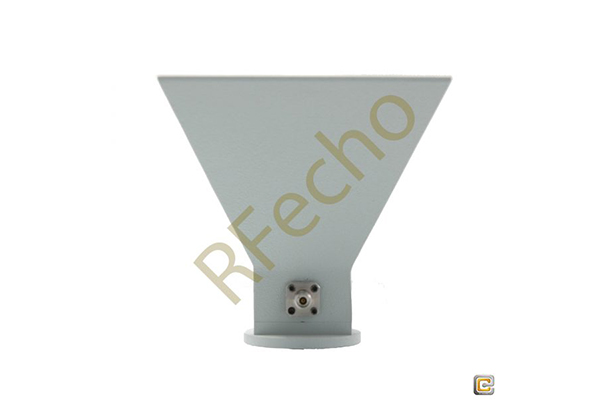
Ultra wide-band dual ridged horn antenna 2-20GHz

Gain: 3.5-13dBi.
VSWR: ≤ 2 Max.
OBH-20200-C Ultra wide-band dual ridged horn antenna also supports higher bandwidth and data rates
This Ultra wide-band dual ridged horn antenna is suitable for use in synthetic aperture radar (SAR) systems
- Description
- Datasheet
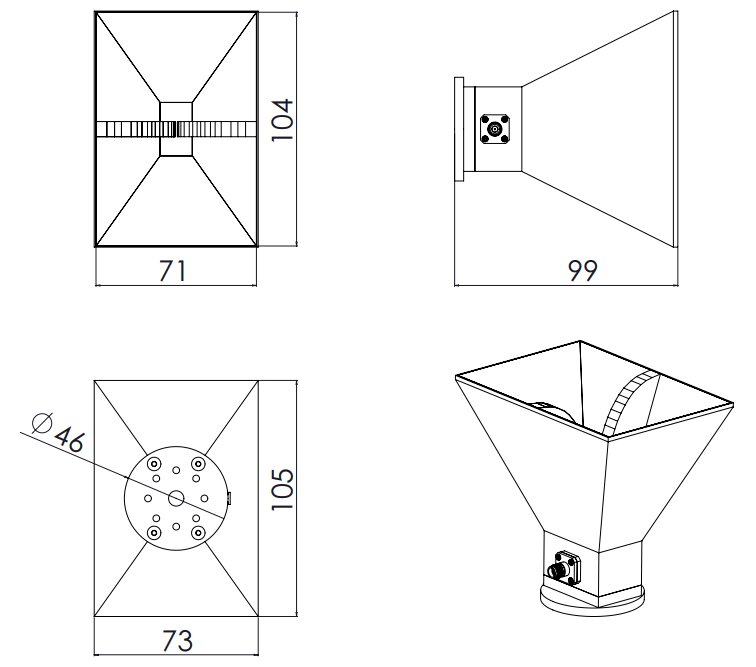
- Outline
- Reviews (2)
Description
The OBH-20200-C Dual-Ridged Horn Antenna designed to operate across a frequency range of 2GHz to 20GHz, effectively bridging the Ku and C bands. ensuring it meets a diverse array of application needs. Weighing only 136 gram can be setup on drone. Throughout its entire bandwidth, the antenna maintains a VSWR of less than 2.0. The test data, including VSWR, antenna factors, gain, and radiation patterns.
This antenna supports higher bandwidth and data rates, essential for next-generation communication technologies.https://www.rfecho.com/product-category/rf-antenna/broadband-dual-ridged-horn-antenna/
Broadband Horn Antenna Specifications | |
| 3.5~13 dBi Gain, 2 GHz to 20 GHz | |
| OBH-20200-C | |
Property | Value |
| Min. Frequency (GHz) | 2 |
| Max. Frequency (GHz) | 20 |
| Gain(dBi) | 3.5~13 |
| VSWR (Max.) | ≤2 |
| Polarization | Single Linear |
| Cross Polar Isolation (dB) | 25 |
| Impedance (Ω) | 50 |
Features | |
| Linear polarized with high polarization purity | |
| Frequency from 2 GHz to 20 GHz | |
| Low return loss / VSWR | |
| Wide bandwidth | |
| Uniform Gain | |
| High Power Handling Capability | |
| Radiation pattern contains only one main lobe over the entire frequency range | |
| Each antenna is calibrated individually in line with ANSI C63.5-2006 | |
Adam Fisher –
We adopt this OBH-20200-C horn antenna for our SAR radar test platform. It provides stable 3.5-13dBi uniform gain across 2-20GHz, and the VSWR never exceeds 2 in full bandwidth. Low standing wave greatly stabilizes our signal acquisition, the wide bandwidth perfectly matches our broadband radar testing demands.
Derek Gordon –
This dual ridged horn works flawlessly for our microwave communication experiments. Smooth gain variation and low VSWR reduce signal reflection errors significantly. It covers ultra-wide frequency bands and supports high power input, reliable for long-term daily RF system debugging.