70–81 GHz Four-Channel Transmitter IC – MH713W


LO input frequency: 17.5 to 20.25 GHz
TX output power: 10 dBm typ.
TX power variation with frequency: −1.5 to +1.5 dB
Supply voltage: 1.1 V, 3.3 V
MIMO operation supported
SPI control interface
Simultaneous or time-division transmission
- Description
- Datasheet
- Functional Block Diagram
Description
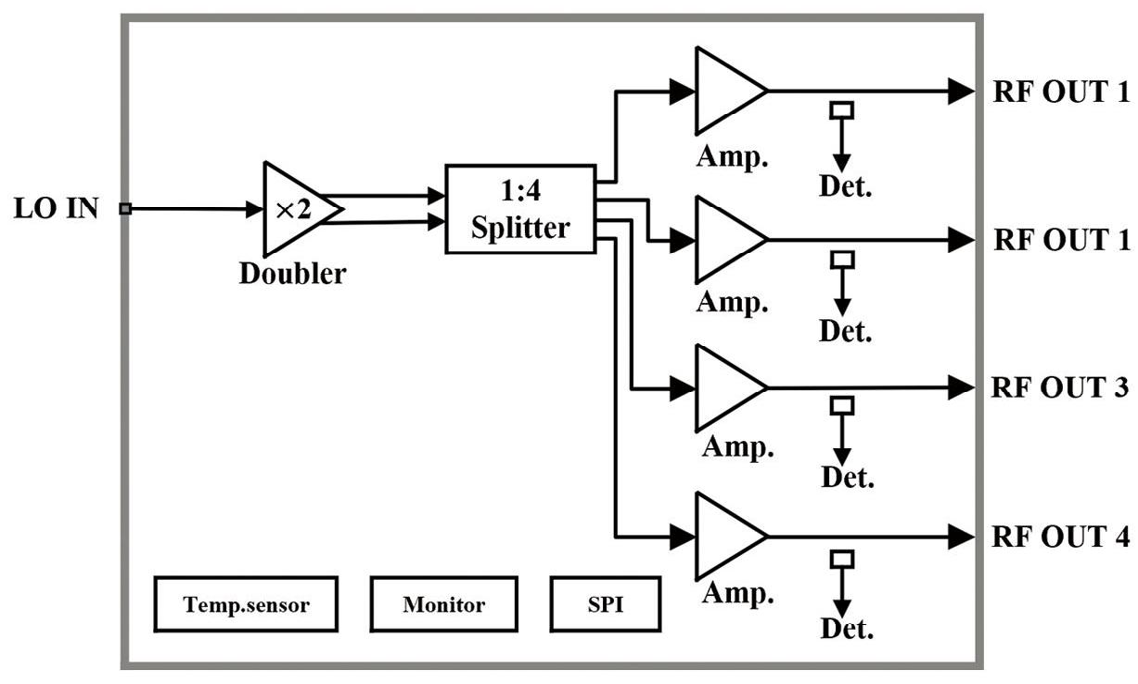
The MH713W is a four-channel transmitter IC covering 70–81 GHz. It integrates a local-oscillator signal path, a 1:4 power splitter, four power amplifiers, a temperature sensor, power detectors and an SPI interface. The four channels support simultaneous or time-division output. Operating state and channel switching are controlled with 3.3 V LVCMOS signals.
Applications: Millimeter-wave security screening, traffic radar, industrial monitoring and fire safety.
Product status: Production.
Four-Channel Transmitter IC Specifications | |
| 70–81 GHz | |
| MH713W | |
Index | Value |
| TX output frequency | 70 to 81 GHz |
| Number of TX channels | 4 typ. |
| LO input frequency | 17.5 to 20.25 GHz |
| LO input power | −12 dBm typ. |
| TX output power | 10 dBm typ. |
| TX power variation with frequency | −1.5 to +1.5 dB |
| TX power variation with temperature | −1.5 to +1.5 dB |
| Channel-to-channel power variation | −1.5 to +1.5 dB |
| Channel-to-channel phase variation | −7 to +7 ° |
| Channel isolation | 30 dB typ. |
| Power-down recovery time | — / 20 / 50 ns (min. / typ. / max.) |
| TX channel switching time | — / 20 / 50 ns (min. / typ. / max.) |
| Supply voltage | 1.1 V, 3.3 V |
| Package / dimensions | BGA, 4.55 × 3.55 mm, 0.5 mm pitch |
Features | |
| MIMO operation supported | |
| SPI control interface | |
| Simultaneous or time-division transmission | |
| Integrated temperature sensor and power detectors | |
| Power consumption: 370 mW, one channel, continuous wave | |
Application Scenarios




Functional Block Diagram