
Low Noise Amplifier
The low noise amplifier (LNA), a critical component in receiver front-end design, has emerged as the essential element for various commercial, military, and scientific applications requiring high sensitivity and minimal signal degradation. LNAs are designed to amplify weak received signals while adding minimal additional noise, thereby determining the overall noise figure of the receiver system. Several performance parameters, such as noise figure, gain, linearity, and bandwidth, define their suitability for different applications. An LNA in a typical receiver chain operates as the first active component that sets the system noise floor and sensitivity. However, in most cases, a balanced optimization between noise figure, gain, and linearity is preferred to handle both weak desired signals and strong interfering signals without distortion. And this is accomplished through careful transistor selection, impedance matching networks, and biasing circuits optimized for low noise performance. However, the fundamental challenge lies in achieving simultaneously low noise figure, high gain, wide bandwidth, and good linearity—parameters that often conflict in amplifier design. As for noise figure optimization, the interaction of transistor bias conditions with source impedance matching, producing the minimum noise figure at a specific operating point. This eventually requires careful trade-off between noise matching and power matching. To retain the optimal noise performance, the input matching network can be designed for minimum noise figure rather than maximum power transfer. As known, when the amplifier is matched for minimum noise figure, the input return loss may be poor. Therefore, balanced amplifier configurations or feedback techniques are preferred alternatives, as they can provide good input matching while maintaining low noise figure, though they may introduce additional complexity and potential stability concerns.
Low noise amplifier-based systems are primarily suited to satellite communications, GPS tracking systems, test and measurement equipment, radar systems, and wireless infrastructure due to their critical role in determining receiver sensitivity. These amplifiers are highly effective for reliably amplifying both weak and strong signals while maintaining system linearity and dynamic range. With the recent development of 5G and millimeter-wave communications, it is often desirable to communicate directly between base stations and user equipment with high data rates regardless of signal path conditions. All modern communication systems have enforced the use of low noise amplifiers to ensure successful links with adequate signal-to-noise ratio at all times. In addition to basic amplification, the need for more and more radio spectrum to be available to users, the absence of suitable installation platforms for too many antennas, the need for improvement in system sensitivity, and the demand for high data rate systems have prompted the development of wideband low noise amplifiers. To meet these requirements, considerable research efforts have been put into developing low noise amplifiers that ensure excellent noise performance across very wide bandwidths while maintaining stability and linearity.
For selecting the Min. and Max., the result will be given as a range including selected values
For the other attributes will be an absolute search, Its better to first chose min and max then filter out
-
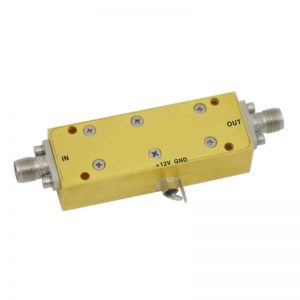 Low Noise Amplifier, Routing
Low Noise Amplifier From 0.01GHz to 10GHz With a Nominal 27dB Gain NF 2.8dB
• Gain: 28dBtypical
• Noise Figure:2.5dB typical
• High P1dB: +15dBmtypical
• Supply Voltage: +12V -
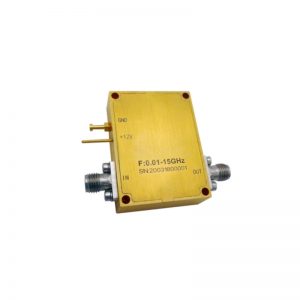 Low Noise Amplifier, Routing
Ultra Wide Band Low Noise Amplifier From 0.01GHz to 15GHz With a Nominal 32dB Gain NF 2.5dB SMA Connectors
• Gain: 32 dB Typical
• Noise Figure: 2.5dB Typical
• P1dB Output Power: +26dBm Typical
• Supply Voltage: +12V @ 320 mA
• 50 Ohm Matched Input / Output -
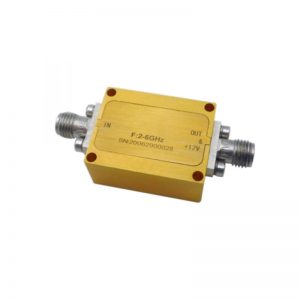 Low Noise Amplifier, Routing
Ultra Wide Band Low Noise Amplifier From 0.01GHz to 18GHz With a Nominal 26dB Gain NF 4.5dB SMA Connectors
• High Output Power 23dBm typical.
• High peak to average handling capability.
• High linearity and low noise figure.
• Convenient AC Power Input. (AC 110V/220V)
• Integrated Heat Sink and Fan. -
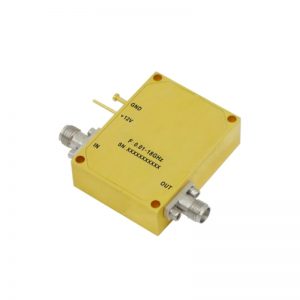 Low Noise Amplifier, Routing
Ultra Wide Band Low Noise Amplifier From 0.01GHz to 18GHz With a Nominal 27dB Gain NF 3dB SMA Connectors
• Gain: 31dB Typical
• Noise Figure: 2.5dB Typical
• P1dB Output Power: +26dBm Typical
• Supply Voltage: +12V @ 320mA
• 50 Ohm Matched Input / Output -
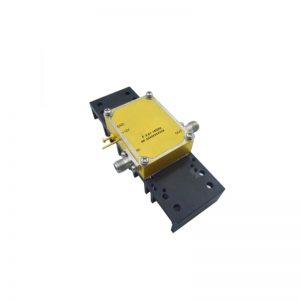 Low Noise Amplifier, Routing
Ultra Wide Band Low Noise Amplifier From 0.01GHz to 18GHz With a Nominal 27dB Gain NF 3dB SMA Connectors
• Gain: 31dB Typical
• Noise Figure: 2.5dB Typical
• P1dB Output Power: +26dBm Typical
• Supply Voltage: +12 V
• 50 Ohm Matched -
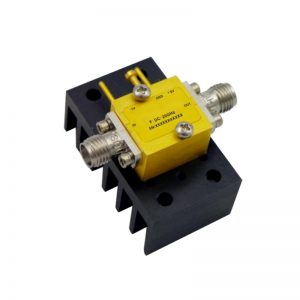 Low Noise Amplifier, Routing
Ultra Wide Band Low Noise Amplifier From 0.01GHz to 20GHz With a Nominal 13dB Gain NF 2.5dB SMA Connectors
• Gain: 14dB Typical
• Noise Figure: 2.5dB Typical
• P1dB Output Power : +12dBm Typical
• Supply Voltage: +8V -
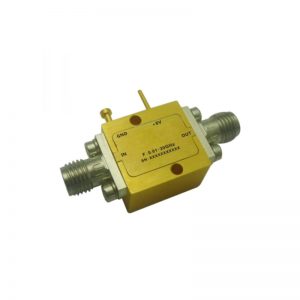 Low Noise Amplifier, Routing
Ultra Wide Band Low Noise Amplifier From 0.01GHz to 20GHz With a Nominal 15dB Gain NF 2.5dB SMA Connectors
• Gain: 17dB Typical
• Noise Figure: 2.5dB Typical
• P1dB Output Power: +18dBm Typical
• Supply Voltage: +8V
• 50 Ohm Matched -
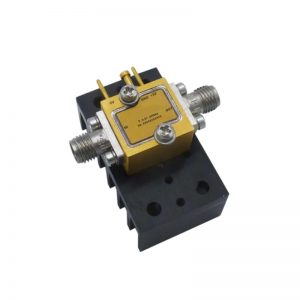 Low Noise Amplifier, Routing
Ultra Wide Band Low Noise Amplifier From 0.01GHz to 20GHz With a Nominal 15dB Gain NF 2.5dB SMA Connectors
• Gain: 15dB Typical
• Noise Figure: 2.5dB Typical
• P1dB Output Power: +21dBm Typical
• Supply Voltage: + 5V&-5V -
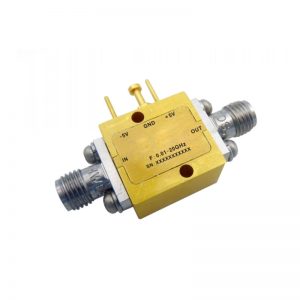 Low Noise Amplifier, Routing
Ultra Wide Band Low Noise Amplifier From 0.01GHz to 20GHz With a Nominal 15dB Gain NF 2.5dB SMA-Female Connectors
• Gain: 15dB Typical
• Noise Figure: 2.5dB Typical
• P1dB Output Power: +21dBm Typical
• Supply Voltage: + 5V &-5V -
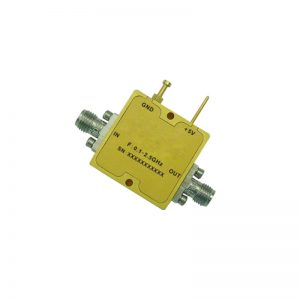 Low Noise Amplifier, Routing
Ultra Wide Band Low Noise Amplifier From 0.01GHz to 20GHz With a Nominal 28dB Gain NF 3dB SMA-Female Connectors
• High Output Power 23dBmTypical.
• High peak to average handling capability.
• High linearity and low noise figure.
• Convenient AC Power Input. (AC 110V/220V)
• Integrated Heat Sink and Fan. -
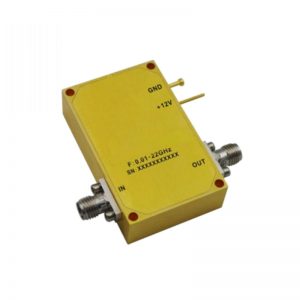 Low Noise Amplifier, Routing
Ultra Wide Band Low Noise Amplifier From 0.01GHz to 22GHz With a Nominal 29dB Gain NF 3.5dB SMA Connectors
• Gain: 26dB Typical
• Noise Figure: 3.5dB Typical
• Output power +28dBm typical
• High P1dB: + 23dBm Full Band
• Supply Voltage: +12 V
• 50 Ohm Matched -
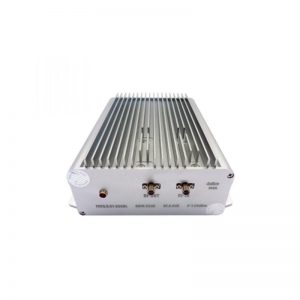 Low Noise Amplifier, Routing
Ultra Wide Band Low Noise Amplifier From 0.01GHz to 30GHz With a Nominal 35dB Gain NF 4dB SMA Connectors
• Gain: 38dB Typical
• Noise Figure: 3.5dB Typical
• P1dB Output Power: 28dBm Typical
• Supply Voltage: AC110V~220V -
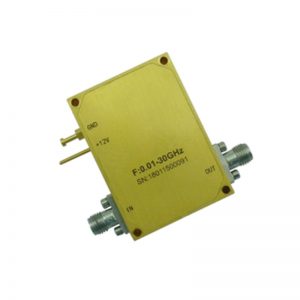 Low Noise Amplifier, Routing
Ultra Wide Band Low Noise Amplifier From 0.01GHz to 30GHz With a Nominal 41dB Gain NF 3.5dB SMA Connectors
• Gain: 41dB Typical
• Noise Figure: 3.5dB Typical
• P1dB Output Power: +28dBm Typical
• PSAT Output Power: 30dBm
• Supply Voltage: +12V @ 525mA
• 50 Ohm Matched -
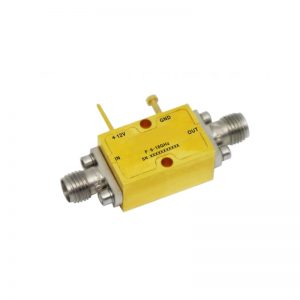 Low Noise Amplifier, Routing
Ultra Wide Band Low Noise Amplifier From 0.01GHz to 3GHz With a Nominal 33dB Gain NF 2.5dB SMA Connectors
• High Output Power > 20dBm.
• High peak to average handling capability.
• High linearity and low noise figure.
• Convenient AC Power Input. (AC 110V/220V)Integrated Heat Sink and Fan. -
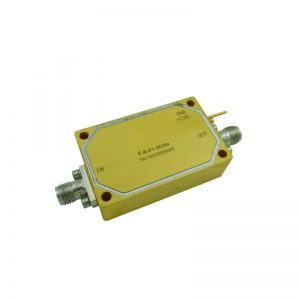 Low Noise Amplifier, Routing
Ultra Wide Band Low Noise Amplifier From 0.01GHz to 3GHz With a Nominal 36dB Gain NF 2.5dB SMA Connectors
• Gain: 36dB Typical
• Noise Figure: 1.5dB Typical
• P1dB Output Power: +21dBm Typical
• Supply Voltage: +12V @220mA
• 50 Ohm Matched Input / Output -
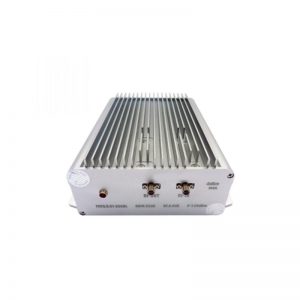 Low Noise Amplifier, Routing
Ultra Wide Band Low Noise Amplifier From 0.01GHz to 3GHz With a Nominal 36dB Gain NF 2.5dB SMA Connectors
• High Output Power > 20dBm.
• High peak to average handling capability.
• High linearity and low noise figure.
• Convenient AC Power Input. (AC 110V/220V)
• Integrated Heat Sink and Fan.